
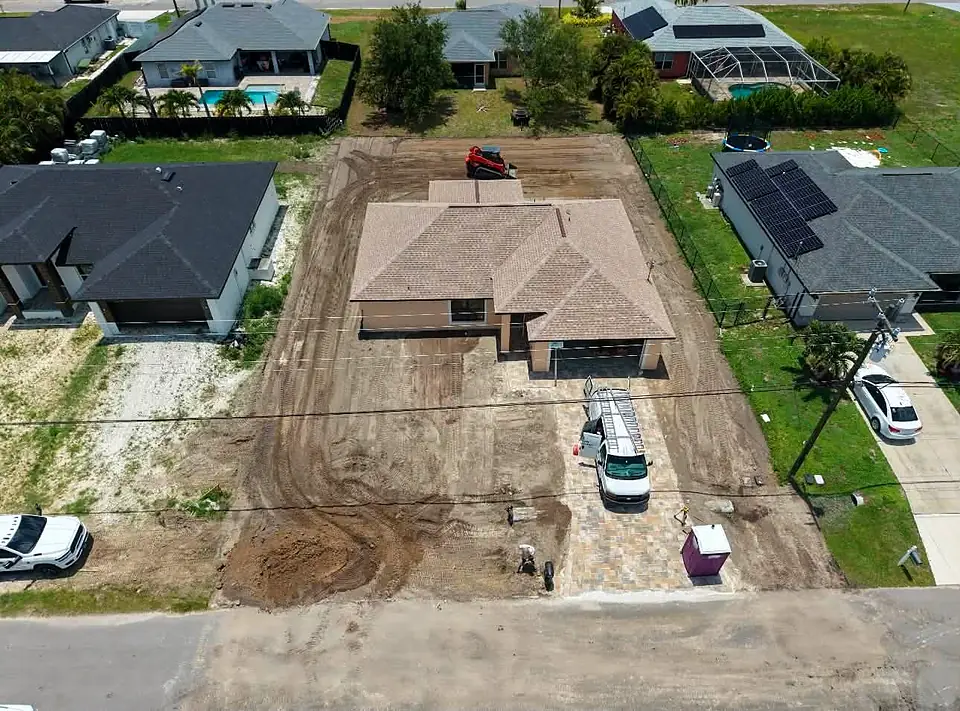
Before the building permit: site plan, septic and well
Lee County's Residential Building Guide asks for a site plan drawn to scale that shows all four lot corners, the lot lines and dimensions, and every easement on the lot. On a lot with septic, an approved septic permit from the Department of Health has to be submitted before the county will issue the building permit. The Department of Health in Lee County charges a $390 application fee and wants a copy of the site survey with the application.
On a lot with a well, the county takes a well affidavit for a new well, or a compliance letter from Lee County Natural Resources for an existing one. Both the septic system and the well have to be finaled before a certificate of occupancy is issued. The septic layout matters to us, because it decides where the pad, the drive and the truck route can go.
Step 1: owls, tortoises and the clearing
Lehigh Acres has many gopher tortoise burrows. Lee County does not use Cape Coral's owl affidavit, but the FWC rules apply statewide: a 33 foot buffer around a burrowing owl burrow from February 15 to July 10 and 10 feet the rest of the year, and 25 feet around every gopher tortoise burrow unless the FWC permits otherwise. Walk the lot and mark burrows before any machine goes on it. Our owl and tortoise guide shows what to look for.
A typical Lehigh lot is far under Lee County's 5-acre line for a vegetation removal permit, so the clearing rides on the house permit. The county's guide says land clearing debris has to be properly disposed of whatever the lot size, so brush and stumps leave in the truck. See lot clearing in Lehigh Acres.
Step 2: how high the house has to sit
In a flood zone, Lee County requires the lowest floor at or above the base flood elevation plus 1 foot, or the design flood elevation, whichever is higher, and a FEMA elevation certificate during construction and again at the end. Outside the flood zones, in X zones, Lee County requires the livable floor to be at least 1 foot above the crown of the road.
That floor height sets how much fill the lot needs. If the final grade will sit more than 18 inches above the crown of the road or any developed lot next door, the county wants a site fill grading plan with the permit application, unless the lot is in a subdivision with an active development order. Our fill dirt calculator turns the numbers into cubic yards.
Step 3: the pad or the stem wall fill
Once the house is staked, the pad goes in. A monolithic slab sits on a compacted fill pad, and a stem wall house gets its height from block with the fill placed inside the walls. We spread and roll the fill in lifts so it passes the density test the builder's plans call for, and we keep it off the septic area and the well. The stem wall vs mono slab guide explains the trade-off.
The county also says a property has to be kept so surface water drains safely. We shape the pad and the yard so rain runs to the swale instead of the house or the lot next door. See house pads in Lehigh Acres.
Step 4: the drive cut, the culvert and the CO
A driveway onto a county road needs a Lee County DOT driveway permit, applied for online through eConnect, with a $95 fee for a single drive and $120 for a double. Culvert pipe in a county right-of-way has to be at least 15 inches in diameter, and the inspector confirms the size at stakeout. The county's certificate of occupancy checklist says the DOT driveway permit has to be finaled before the CO. The Lee County culvert guide has the inspection steps.
Drainage in Lehigh Acres is run by the Lehigh Acres Municipal Services Improvement District, which took over from the East County Water Control District in 2015. Its permits are aimed at larger parcels, not typical quarter- and half-acre home lots. If you are building on acreage, call LA-MSID at (239) 368-0044 before the site work starts. Then the lot gets its final grade and sod, and the house is ready for the CO.
The short version
- On septic lots, the Department of Health septic permit comes before the Lee County building permit.
- Outside flood zones the livable floor sits at least 1 foot above the crown of the road; in flood zones, base flood elevation plus 1 foot.
- Final grade more than 18 inches above the road crown or a developed neighbor triggers a site fill grading plan.
- Owls get 33 feet in nesting season and 10 feet otherwise; tortoise burrows get 25 feet, under FWC rules.
- The Lee DOT driveway permit has to be finaled before the certificate of occupancy.
Quick answers
Do I need a permit to clear a lot in Lehigh Acres?
Not a separate one for a typical lot. Lee County's single-family vegetation removal permit starts at 5 acres, so clearing a quarter- or half-acre lot rides on the house permit. The FWC owl and tortoise rules still apply, and the debris has to be disposed of properly.
How high does a new house in Lehigh Acres have to be?
In an X zone, Lee County requires the livable floor at least 1 foot above the crown of the road. In a flood zone, the lowest floor goes to base flood elevation plus 1 foot or the design flood elevation, whichever is higher.
When does Lee County want a fill grading plan?
When the final grade on the lot will be more than 18 inches above the crown of the road or any developed lot next door, unless the lot is in a subdivision with an active development order.
Does the septic system change where the pad goes?
Yes. The septic permit comes first, and the tank and drainfield location decides where the pad, the drive and the truck access can go. Send us the site plan with the septic layout and we will plan the fill around it.
Can Chops do all the site work on a Lehigh Acres lot?
Yes: clearing, the pad or stem wall fill, the drive cut and culvert, base rock and final grade. Call (239) 560-2996, or (305) 506-7420 en español, and send the survey and site plan for a free quote.
See our house pads & lot fill or call (239) 560-2996.