
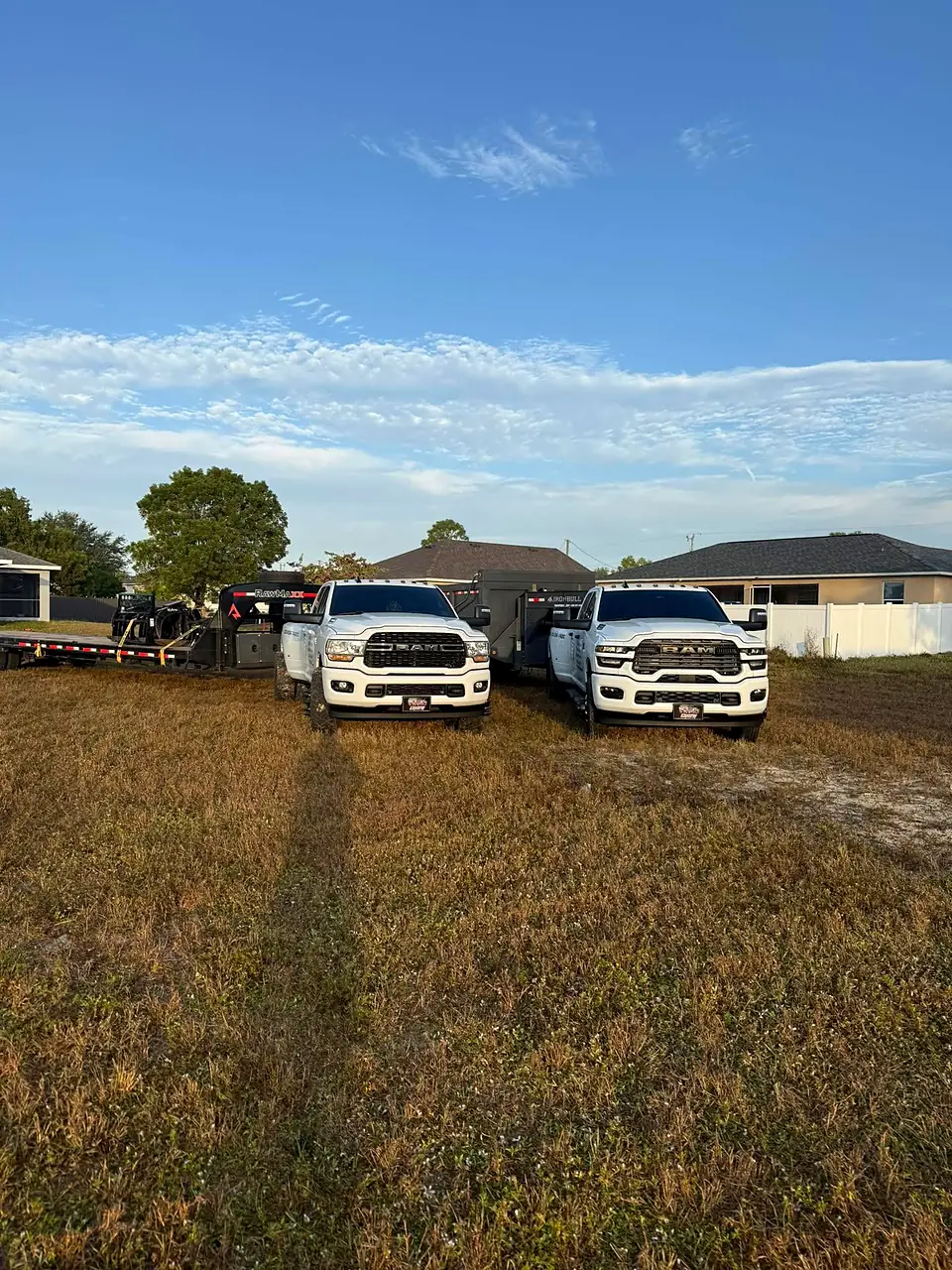
Size is where the price starts, not where it ends
Square footage tells us roughly how many hours the machine will run, and that is about all it tells us. A 10,000 square foot lot (80 by 125 feet) covered in grass and low palmetto can be stripped and raked in a short visit. The same footprint grown over with a pepper thicket, a few big pines and a pile of old dumped yard waste is a different job with different trucks.
The other half of size is how much of the lot you actually need cleared. Clearing only the house footprint, driveway and a working strip around the pad is a smaller job than taking the whole parcel to bare sand. On acreage in Lehigh Acres or North Fort Myers, people often clear the building area and an access road first and leave the rest for later. Tell us what you plan to build and we will price the clearing to that plan.
What is growing on the lot changes everything
Grass, scrub and small palmetto come off fast. Mature pines and oaks bring root balls that have to be pulled and either hauled or mulched, and every stump that comes out leaves a hole that has to be filled and packed back.
Brazilian pepper is the big one in Cape Coral. It grows in dense, many-stemmed thickets, it is on the Florida Noxious Weed List according to UF/IFAS, and it sprouts back from roots left in the ground, so it has to be grubbed out, not just cut. Its sap can irritate skin, which slows hand work around it. Melaleuca, with its white papery bark, is on both the federal and Florida noxious weed lists and usually grows where the ground is wet, which slows machines down. The city's vacant lot mowing program no longer responds to complaints about pepper trees, so on many lots it has had years to spread.
Burrowing owls and gopher tortoises
Wildlife can change the schedule and the method more than any tree. In Cape Coral, burrowing owl nesting season runs February 15 to July 10. During nesting season the city requires a 33 foot buffer around a burrow, and at least 10 feet the rest of the year. Gopher tortoise burrows get a 25 foot buffer year-round under FWC rules. Working inside those buffers takes an FWC permit, and the city tells applicants to file owl permit requests six to eight weeks early.
A burrow near the middle of the lot can mean working around a staked zone, waiting for a permit, or waiting out the season. None of that has to be a surprise. We look for burrows when we walk the lot, and our guide to owls and tortoises before clearing covers the permits and the affidavit in detail.
Haul it off, mulch it, or burn it
Where the debris goes is often the largest single swing in a clearing quote. Hauling means loading trucks and paying for disposal, and Lee County requires residential lot clearing debris to be properly disposed of or recycled no matter how small the lot. Mulching in place with a forestry mulcher leaves a layer of chips on the ground and skips most of the trucking, which works well on acreage and access roads. Under a house pad, though, roots and organic material have to come out, because Cape Coral requires a density test in the bottom of the foundation and buried wood will not pass.
Burning is the option people ask about most and use least. Land clearing burns need Florida Forest Service authorization, and state rules set land clearing piles 1,000 feet from other people's occupied buildings unless an air curtain incinerator is used. In Cape Coral the fire department also requires an $80 burn permit fee. On a city lot with neighbors on three sides, it rarely pencils out. Our forestry mulching page explains where mulching makes sense.
Access, wet ground and what is next door
A lot with a wide, dry frontage on a paved street is easy to work. Price goes up when the machine has to squeeze between a neighbor's fence and a power pole, cross a deep swale, or work along a canal bank where nothing can go in the water. Overhead lines limit how trees can be dropped. Buried lines matter too: if we are grubbing stumps or digging, Florida law requires a Sunshine 811 ticket at least two full business days before the dig.
Season counts. The South Florida wet season runs May 15 to October 15, and a low lot that holds water in August can rut badly under loaded trucks. The same lot in March is firm and quick. If your schedule has room, clearing in the dry months usually means fewer delays and a cleaner finished surface.
What comes after clearing: fill and grade
Clearing is step one, and a cleared lot is often lower than the road once the brush and topsoil are gone. If you are building, the next questions are how much fill the pad needs and what the rules allow. Cape Coral caps on-site fill at 12 inches in flood zones unless the Building Official approves more, which is a big reason stem walls are common here. In unincorporated Lee County, a site fill grading plan is required when final grade will sit more than 18 inches above the road crown or a developed neighbor.
Ask for clearing and fill as separate lines on one quote so you can see both. Doing them with the same contractor can save a second trip to bring the machines back. Our guide on how much fill dirt you need walks through the math.
How to get a quote you can actually compare
Lot clearing quotes are hard to compare because each contractor assumes something different. Before you sign, ask every bidder the same things. Are stumps grubbed out or cut flush? Are roots raked out or left? Is the debris hauled, mulched or left in piles? Is any fill or final grading included? Who checks for owl and tortoise burrows, and who signs the affidavit?
Send us the address or parcel number, a few photos, and what you plan to build, and Chop will walk the lot himself and write a free quote that answers each of those questions. You can start on our lot clearing page or go straight to the contact page. Call (239) 560-2996, or (305) 506-7420 for Spanish.
The short version
- Square footage sets a baseline, but brush density, stumps and Brazilian pepper move the price more.
- Owl and tortoise burrows can add buffers, permits or waiting time, so look for them before you book.
- Haul-off, mulching and burning are priced very differently, and organic material cannot stay under a house pad.
- Tight access, canal banks and wet season ground all add machine time.
- Get clearing and fill priced as separate lines so quotes are comparable.
Quick answers
How much does it cost to clear a 10,000 sq ft lot?
Most lots we clear run $2,500 to $7,000, depending on the trees. A 10,000 square foot lot of grass and light scrub is a short job, while the same size lot thick with Brazilian pepper, big pines and stumps takes much longer and fills more trucks. Owl or tortoise burrows, debris disposal, tight access, wet ground and any fill you need afterward all change the number. The fair way to price it is to look at it, so call (239) 560-2996 and Chop will walk the lot and give you a free quote.
Does mulching cost less than hauling the debris away?
Often, because mulching in place skips most of the truck loads and disposal. It fits acreage, access roads and areas you are not building on. Under a house pad or driveway the roots and organic material still need to come out so the ground can pass compaction and density testing.
Is a separate permit needed to clear a Cape Coral lot with no building permit yet?
On a single-family lot, clearing and fill are normally covered by the house building permit. Clearing without one generally needs a separate land clearing and fill permit under the city's land development code, so check with the Permitting Services Division before any machine goes on the lot.
Why did two lot clearing quotes for the same lot come in so far apart?
Usually because they priced different jobs. One may include grubbing stumps, raking roots and hauling everything away, while the other cuts flush and leaves piles. Ask each contractor to spell out stumps, roots, debris, fill and wildlife checks so you are comparing the same scope.
Are permit fees part of the cost of clearing a lot?
They are separate from the contractor's price and depend on where the lot is. In unincorporated Lee County, a single-family lot of 5 acres or more needs a Vegetation Removal Permit, which the county lists at $30 plus $1 per tree, not to exceed $25 per acre, doubled for after-the-fact permits. Charlotte County lists a $55 environmental inspection fee and a $70 single-family residential tree permit, plus $1 per caliper inch of trees removed. Burning in Cape Coral adds the fire department's $80 burn permit. Confirm current fees with the office before you apply.
See our lot clearing or call (239) 560-2996.